LiveWorkPlay Commemorates National Disability Employment Awareness Month (NDEAM) October 2026
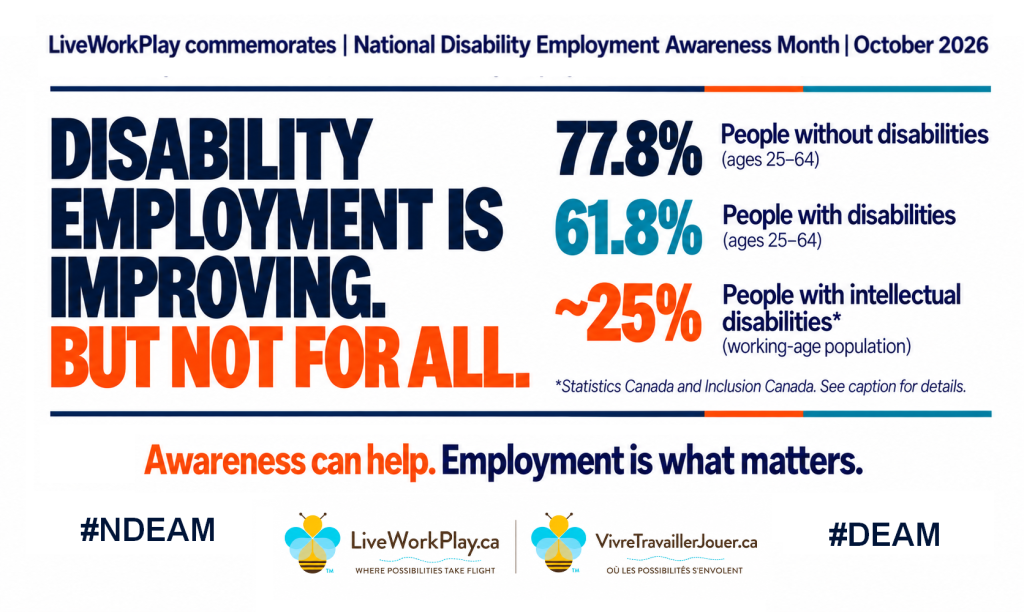
Disability employment is improving. But not for all.
October is National Disability Employment Awareness Month.
In Canada, 77.8% of working-age people without disabilities are employed. For people with disabilities overall, the figure is 61.8%.
That disparity matters. Broad improvements in disability employment do not necessarily mean equitable outcomes for everyone. People with intellectual disabilities continue to face extraordinary and systemic exclusion from the labour market.
This concern is not only about practice. Ontario retains an archaic provision, rooted in a sheltered-work model established in provincial law and policy more than 65 years ago. The provision excludes people who perform work in a simulated job or working environment for the primary purpose of rehabilitation from the protections of the Employment Standards Act.
Community participation matters. Volunteering can be a wonderful choice. Learning and skill development can be valuable. But none of these should replace paid employment for someone who wants to work.
At LiveWorkPlay, we also know something very different is possible.
Every day, we see people with intellectual disabilities and autistic persons contributing as valued employees and coworkers. We see employers removing barriers, reconsidering conventional recruitment practices, building inclusive workplaces, and discovering talent they might otherwise have overlooked.
Those successes deserve recognition.
They should also make us ask why they are still out of reach for so many people.
We’ll celebrate what is working.
And we’ll keep asking what needs to change.
Awareness can help, but employment is what matters. Alongside efforts to change attitudes, systemic reforms are still needed to remove barriers and advance inclusion.
About the numbers: Statistics Canada reports employment rates of 77.8% for Canadians without disabilities and 61.8% for Canadians with disabilities, ages 25–64, in 2022. Inclusion Canada reports that approximately 1 in 4 working-age people with an intellectual disability are employed. These are not identical statistical measures, and Canadian data specific to intellectual disability remain limited. “Employed” also does not necessarily mean full-time, sustained employment or adequate earnings. We use these figures to illustrate the scale of the disparity rather than suggest a precision the available data cannot support.
About NDEAM: NDEAM is not a recent marketing campaign. Its roots reach back to 1945, when disabled veterans were returning from the Second World War and the United States established a national week recognizing the contributions of workers with physical disabilities. The language and scope evolved over time, expanding to people with all types of disabilities in 1962 and becoming a month-long observance in 1988. At its core was a challenge to the assumption that disability should mean unemployment. It was part of a longer struggle for the right to work, to contribute, and to be recognized as an equal participant in economic life.
In Canada, provincial recognition began with Manitoba in 2010 and spread to other provinces and territories. This provincial engagement helps explain why the campaign is often known in Canada as DEAM rather than NDEAM, although both names represent the same movement. Many disability employment champions have since amplified the campaign and its modern messaging, while its roots remain firmly grounded in rights, opportunity, and the refusal to accept exclusion from the labour market.
Today, organizations including the Ontario Disability Employment Network, the Canadian Association for Supported Employment, the Canadian Council on Rehabilitation and Work, and many regional and local partners continue to lead and amplify NDEAM and DEAM across Canada.